 Skip to content
Three printing methods, one question, and an internet full of chemistry lectures. Two of these are acronyms one letter apart; the third sounds like a window-cleaning tool. So which printing method should you choose? The answer comes down to two things: what the garments are made of, and how many you need. Our Lindon shop decorates thousands of tees a month using all three of these methods, and this question comes up on nearly every apparel order. This post answers it, plus enough detail to make you dangerous on your next vendor call.
What is DTG printing?
DTG is direct-to-garment. Picture your office inkjet printer, scaled up and pointed at a t-shirt. Water-based ink gets sprayed directly into the fibers, then heat-cured so it stays there.
Because the ink goes into the fabric instead of sitting on top of it, a DTG print has almost no feel. Run your hand across it and you’re mostly just touching shirt. That’s the whole appeal.
The catch: the ink needs natural fibers to soak into. Give DTG a 100% cotton tee and it’s brilliant. Give it a polyester performance polo and the ink has nothing to grab, so the print comes out dull and washes out fast.
DTG is the one method of the three we don’t run on our own floor; we place it with trusted decoration partners, and quantity usually decides when it’s the right call. More on that below.
What is DTF printing?
DTF is direct-to-film. The design gets printed onto a film, dusted with a powdered adhesive, cured, and then heat-pressed onto the garment. The print arrives as a thin, flexible layer bonded to the surface.
Because it’s bonded on rather than soaked in, DTF doesn’t care what the shirt is made of. Cotton, polyester, blends, nylon, a canvas tote, a trucker hat: if a heat press can reach it, DTF will stick to it.
If you’re picturing the crunchy iron-on transfers from your little-league days: no. Modern DTF is thin, stretchy, and looks sharp. The technology grew up.
The catch: polyester fights back. Press heat (typically 280–325°F) can turn a poly garment’s dyes gaseous, and they creep into the transfer’s white ink layer. The industry calls it dye migration; you’ll call it a white logo drifting pink on a red shirt, sometimes days after pressing. The worst offenders are 100% poly in bold colors (red, black, navy, maroon, royal), sublimated poly, and some performance fabrics and blends. Low-temperature transfers, shorter press times, and cooling between presses all shrink the risk. We press DTF in-house in Lindon, and a suspect garment gets a test press before the full run starts. Even so, on heavy polyester runs the risk never quite disappears, which is where the next method comes in.
What is a Digital Squeegee?
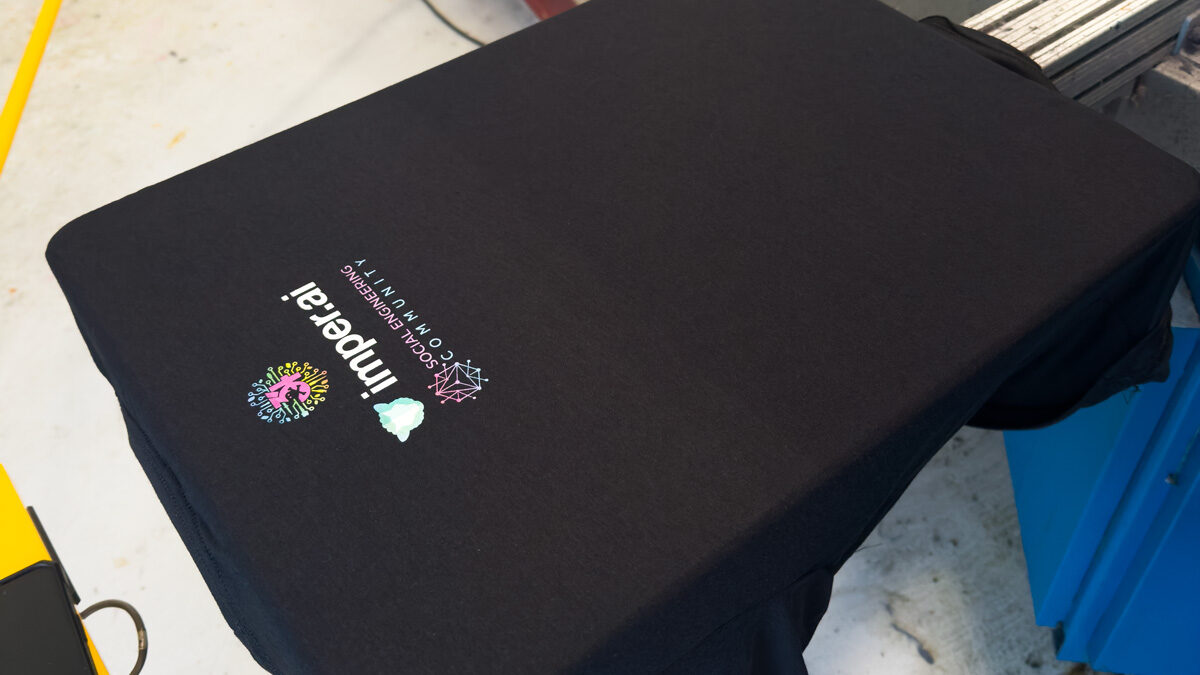
Digital Squeegee is the one your neighbor hasn’t heard of. We run one on our own production floor in Lindon; the shirt in the photo at the top of this post came off it. It gets mistaken for DTG because they both print digitally, but it’s actually a hybrid: the durability and feel of a screen print, with the photographic detail of digital, on the same shirt. The foundation is what changes everything.
The process starts like a traditional screen print. A white underbase goes down first. On polyester, a blocker screen goes down with it: a physical barrier that stops garment dye from bleeding into the print. That’s the dye migration problem from the DTF section, solved with a layer instead of a workaround. Once that foundation is in place, the digital head prints the full-color image directly on top.
The result reads like premium screen printing, because underneath it is one, with detail no screen could hold on its own. And unlike DTG, it isn’t limited to cotton. With the right screen setup it handles cotton, blends, and 100% polyester performance apparel without flinching.
The catch: the trade-off is the one screen printing has always had. Screens mean setup, and setup means volume is where it earns its keep. This is a method for two hundred shirts, not two.
How do DTF, DTG, and Digital Squeegee compare?
| DTG | DTF | Digital Squeegee | |
|---|---|---|---|
| Fabric | 100% cotton is home turf | Basically anything | Cotton, blends, and 100% poly with the right screen setup |
| Feel | Softest print there is; the ink lives in the fabric | Thin surface layer; you’ll notice it on big solid designs | Premium screen-print feel |
| Color on dark or synthetic garments | Good on dark cotton, struggles on synthetics | Bright on everything; watch for dye migration on 100% poly | Excellent: screened underbase, plus a blocker on poly |
| Detail and gradients | Excellent; photo-quality on the right shirt | Very good; crisp lines, clean small text | Photographic, with screen-print depth |
| Durability | Fades gradually, but never cracks or peels; the ink is the fabric | Holds color longer; can peel if poorly applied | Screen-print tough; the benchmark |
| Order size sweet spot | Small to medium runs | Small to medium runs, especially mixed-garment orders | Medium to large runs; screens mean setup |
Which fabrics can each method handle?
DTG is a cotton specialist. DTF is a generalist. Digital Squeegee is a generalist with a prep list: the blocker screen is what lets it print on polyester that would sabotage other methods. If your order mixes cotton tees, poly quarter-zips, and a dozen hats (and that describes most of the orders we see), DTF covers the whole lineup with one method. If the order is two hundred performance shirts with a full-color design, Digital Squeegee was built for exactly that job.
Which print feels the softest?
DTG is the softest print there is; the ink becomes part of the shirt. Digital Squeegee feels like high-end screen printing, which is what most people picture when they picture a “real” printed shirt. DTF has a slight surface presence. It’s flexible, not plasticky, but on a large solid print you’ll know it’s there. Nothing like a sticker, despite what the transfers of your childhood taught you.
Which print is the most durable?
Digital Squeegee sets the bar. It’s screen printing at heart, and screen printing is the thing every other method gets measured against. Below that, DTF and DTG don’t wear out so much as wear differently. DTF holds its color through hard washing but can peel or crack if it was pressed badly in the first place. DTG can’t peel, because there’s nothing on the surface to peel; it just fades gradually, getting softer and more vintage with every laundry cycle. Some people pay extra for shirts that look like that on day one, so “fading” isn’t always an insult. It’s just physics you should know about before you order staff apparel. (How the shirt gets washed and ironed matters as much as the method. We covered that side in Can You Iron a T-Shirt?)
Which method works best on dark or synthetic garments?
DTF prints its own white underbase, so colors stay loud on black, navy, red, whatever. The asterisk is 100% polyester, where that white layer is exactly what garment dyes migrate into. Low-bleed transfers help; they don’t make it foolproof. Digital Squeegee puts a blocker behind its underbase, which makes it the most color-stable option on athletic poly. DTG can print on dark cotton with an underbase, but on polyester the ink has nothing to grab. It’s not a fair fight.
How does quantity change the price?
This is where Digital Squeegee changes the math. DTF and DTG need no screens and no setup, which is why they exist: a small run carries no setup cost. Between those two, DTG is often cheaper at the lowest quantities (no film, no powder, fewer steps), while DTF gains ground as orders grow, because multiple designs can share a single sheet of film, which the industry calls a gang sheet. Digital Squeegee plays a different game entirely. It pays a setup cost up front, then gets more economical with every shirt after. Small runs, go digital-only. Big and repeatable, the hybrid starts winning, and it brings screen-print durability with it. Whichever way it goes, quantity, garment, and design size drive the price more than the method does.
So which printing method should you choose?
Here’s the answer most vendors dance around: it depends on your garments and your quantity, not your artwork. All three print detail beautifully. The order decides.
- DTG if the run is small, the shirts are cotton, and softness is the point: retail-style merch people will wear on purpose.
- DTF if the order mixes garment types, includes blends or performance wear in modest quantities, or is too small to justify screens. For heavy runs of 100% polyester, read the next one.
- Digital Squeegee if the run is big, the art is complex full-color, and the shirts need to survive real life: staff uniforms, events, and performance apparel at scale.
And sometimes none of the above. Huge run of a one-color logo? Classic screen printing still wins on price, and it’s not close. Polos and jackets? Embroidery brings a weight no print can fake. (Our complete guide to screen printing and embroidery covers both.) A decorator who only recommends the machine they own isn’t giving you advice — they’re giving you a sales pitch with extra steps.
What is a Digital Squeegee print, in one sentence?
A hybrid printing method: a screen-printed white underbase (plus a blocker screen on polyester) with a full-color digital print on top. Screen-print durability and feel, digital-level detail.
Is Digital Squeegee the same as DTG?
No, and it’s a common mix-up because both print digitally. DTG jets ink straight into bare fabric and only thrives on cotton. Digital Squeegee builds on a screen-printed foundation, which is what unlocks polyester, dark garments, and screen-print durability.
Is DTF or DTG more durable?
Between those two, DTF holds color better through heavy washing, but they fail differently. A well-pressed DTF transfer resists fading, while a badly pressed one can peel. DTG never peels (the ink is in the fabric); it just fades slowly. If durability is the whole question, Digital Squeegee outlasts both.
Does DTF feel like a sticker?
Not anymore. Modern DTF is thin and flexible. DTG is still softer on cotton, but the gap has closed a lot.
Can DTG print on polyester?
Barely, and you won’t like it. The ink wants natural fibers. For polyester and performance fabric, DTF handles small runs and Digital Squeegee handles big ones.
Does DTF have dye migration problems?
It can. The transfer itself doesn’t migrate; the garment’s dyes do. Under press heat, polyester dyes can bleed into the transfer’s white ink layer, turning white graphics pink on red shirts or tan-gray on black ones, sometimes days after pressing. Low-temperature transfers, shorter press times, and testing suspect garments all reduce the risk. When color stability on athletic poly is non-negotiable, Digital Squeegee’s blocker underbase is the more robust answer.
Is DTF cheaper than DTG?
It flips with quantity. DTG is often cheaper at the lowest quantities: no film, no powder, fewer steps. DTF gains ground as orders grow, because multiple designs can share a single sheet of film (the industry calls this a gang sheet). Either way, quantity, garment, and design size drive the price more than the method does.
Which is better for small orders?
DTF or DTG; neither needs screens or setup fees, which is why they exist. Digital Squeegee wants volume, since the screens have to pay for themselves. Cotton favors DTG; everything else favors DTF.
Every garment and design combination behaves a little differently, and whoever decorates your apparel should be able to explain why they’re recommending a method. If the answer is “it’s the machine we have,” keep asking questions. We’ve spent close to twenty years matching orders to methods. We run a Digital Squeegee on our own floor, press DTF in-house, and place DTG with trusted partners, so whichever way your order points, we can take it there. If you have an order in mind, send us the garments, quantities, and artwork through our quote request form and we’ll tell you which method fits, and why.